Family History Book ~ Philip J. Grace Sr.
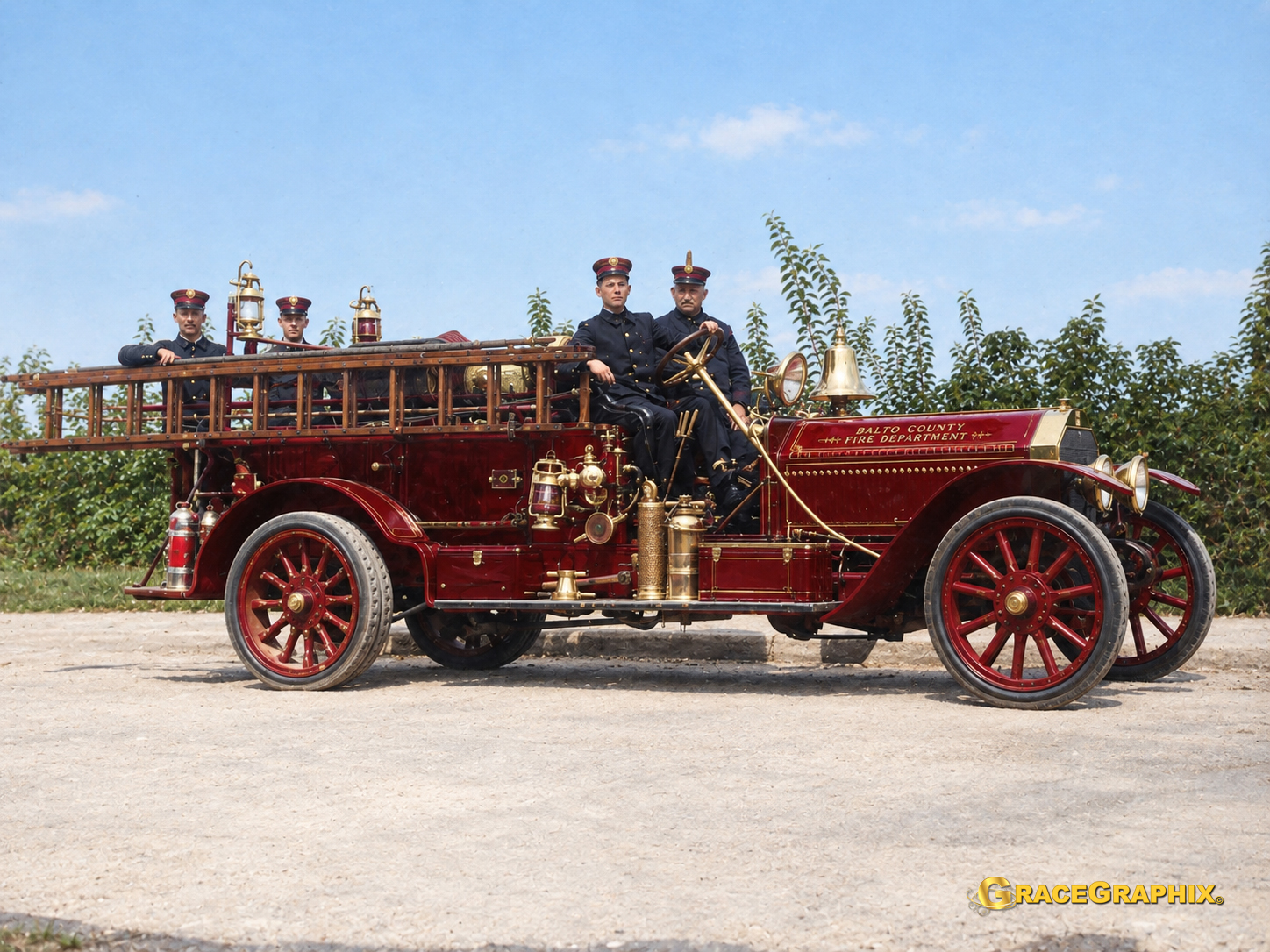
One of only two known photographs of Philip John Grace Sr.
Based on the articles, vehicle and the uniforms, this is about 1920-1922
the original photo was captured in black and white ~ colorization for commemorative purposes
The 1918 Baltimore City annexation of Baltimore and Anne Arundel Counties took effect on January 1, 1919. Then, Captain Philip Grace was with Engine Company 47, Mt. Winans which had now become part of Baltimore City. His title became Lieutenant as did the other captain’s titles that were part of the annexation. According to an article published in the Municipal Journal, a semi-monthly Baltimore City publication, Philip’s crew were fireman John F. Grace, George M. Shultheise and William J. Rose. Note John F. Grace was the son of Philip’s first cousin, John Grace of Mt. Winans/Morrell Park, the son of the younger brother or Philip’s father, James Grace and lived on Washington Boulevard.
1919 and 1920 were a period of transition for the annexed county fire departments.
In 1920, in order to extend fire protection throughout the county, a number of fire department implementations were made but not properly recorded. One of which was that Engine #6 Halethorpe operated a 1913 American LaFrance Pumper, but the exact date that went to effect was not noted.
By 1921, five combination Fire and Police Department buildings had been completed and staffed replacing previous departments. The Fire Department Station in Relay was replaced by the Halethorpe Fire Department, which was one of these combination departments, on the corner of Washington Boulevard and Halethorpe Farms Road. This photo was taken in front of that building and is also where Philip would serve until his forced retirement sometime shortly after June 1922.
Based on a newspaper clipping in the Baltimore Sun dated December 24, 1919 which stated county appointments, the Baltimore County Relay Fire Station had four names: Philip Grace, Charles Rappanier, Joseph Noto and Robert H. Young in that order. Because Philip retired in mid 1922, this photo is being dated between 1920-1922 in front of the Halethorpe Station which replaced the Relay Station in 1920 or 1921.
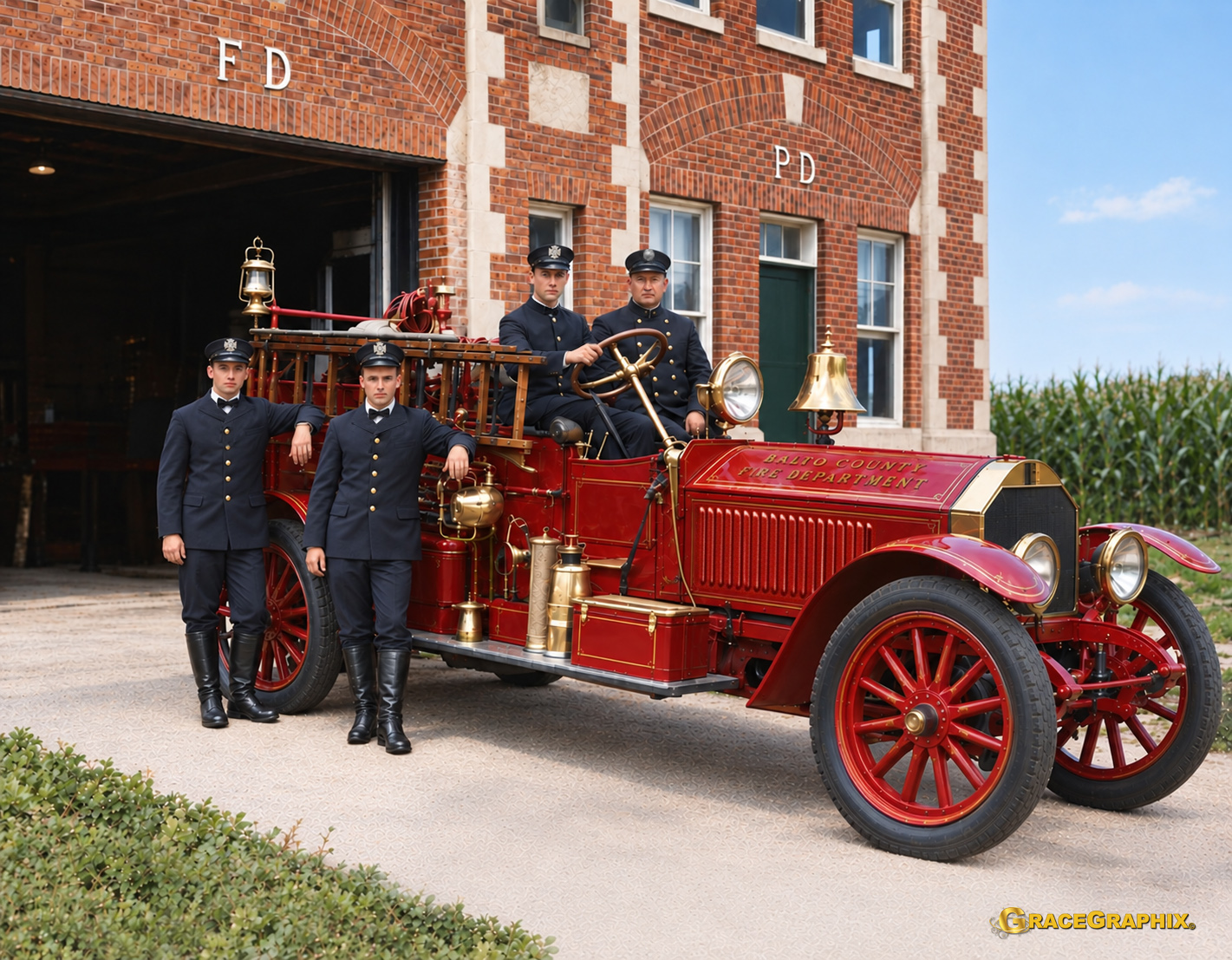
Another version with AI assistance
This version went through several iterations because the AI model believed the uniforms of that day were a white dress shirt with a four in hand tie and the jacket had lapels. This may have been true for some jurisdictions, but the original colorized photo does not lie. Much research went into the uniforms such as single or double breasted jacket depending on rank as well as what rank wore the stiff military-style collars. The crest on the dress uniform hats also played a role in designating rank.
The faces are AI approximations. Special attention and eventual manual intervention went into the representation of Philip Grace. The original photo as well as photos of Philip Grace Jr., when he was about the same age, were referenced to render this composite face.
Part 1 (1879-1880) Philip Grace Jr. as a Youth
There exist a collection of 11 newspaper articles that were published in the Baltimore Sun from December 1879 to October 1880 detailing the arrest and trial of Philip Grace and about a dozen others involved in what was called the “Midnight Train Rioting” which look place on Christmas Eve 1879 at about 11:15pm. Apparently, the train consisted of an engine and two cars. If you take the time to read the articles, it would seem that the first car is what they referred to as the smoking car and the second or last car is referred to as the ladies car.
It’s unclear whether the riotous acts took place from Camden to Relay Stations or vice versa. The stations mentioned are Camden, Mt. Winans’, Carrsville, Smearden and Relay. The trial interest seem to focus on whether this rioting or disorderly conduct look place within the city limits which, at that time, would have been between the Mt. Winans’ and Camden Stations.
What specifically initiated the fighting is unclear. There seem to be racial overtones in these articles, but that may also be because we are reading them today. In today’s news, accused are seldom identified as black or white, but back in the late 1800’s and even in the mid 1900’s, many people were identified as “colored” or “black” in most publications. Keep in mind that this is also 1880 and only 17 years after the Emancipation Proclamation.
One of the good things that came about as a result of this riot was a change of empowerment for the conductor of such vehicles or any public transportation vehicle. The name of the company that owned the train is undisclosed, but as a result of the incident, they deployed the 1860 Presidential Commission Act giving conductors, as “employees of the road”, sovereignty. As such, the conductor is fully empowered to arrest offenders in such occurrences.
Those initially implicated as participants in the riot were Thomas Chisley, William Gray, Philip Grace, George and Richard Smarden, Henry Dearing, Jr., William Wade, Edward Effert, Robert Coursey, Wesley Wade, John Tabb, Frank Robinson, Silas Beall, Jason Reilly, Christian and Henry Heile and John Crabb .Later indicted were Adam Bender, William Morgan. Having done much reading on the history of Lansdowne and the boulevard as well as Federal Census Records, I readily recognize many of the these names as those who lived or owned farms in this area at that time.
Moving through the articles, it became a process of elimination through testimonies. Philip Grace and William Wade were among those that could not make their initial court appearances due to the severity of their injuries as attested to by the local Dr. Hall. Other impediments were the failure to appear of witnesses for the prosecution so this prolonged the trial for several months.
Finally on Wednesday, October 20, 1880, Henry Dearing, George Smearden and Philip Grace were found guilty. The following day, a fine was imposed on all three men for their participation in the riot which amounted to $20 plus court cost. That amounted to $71.43 each.
Doesn’t seem like much? Using a 2.4% inflation rate, this would amount to $2,129.78 in today’s dollars.
Philip would have just turned 21 years old at the time of this offense and it would appear he was a bit of a hellion as a youth.
Part 2 (1906-1919) Philip’s Health & Career
February 28, 1906 One article, which is very interesting, reports of an incident involving Michael John Goeller 14 years before John J. Grace (Philip’s son) would marry Margaret Goeller (Michael John Goeller’s daughter). It is also telling of a time line. In the 1900 Census, Philip’s occupation was a machinist so somewhere between 1900-1906 he became a fireman with the Mt. Winans’ Fire Department. In the 1900 Census, Michael Goeller’s occupation was railroad watchman living in Westport, which is adjacent to Mt. Winans’ so he was likely an employee of the B&O Railroad working at Mt. Winans’ Station. Just a note, the 1910 Census finds both of them with their same respective occupations living on Washington Boulevard.
August 7, 1909 According to the article, there was apparently a bit of a rumpus or argument between the Mt. Winans’ Fire Dept. and the Lansdowne Volunteer Fire Dept. who it would seem responded to the same fire. I am guessing the dispute would be procedural because there was likely no standardized training in place, especially for volunteers. Philip would be 50 years old at this time with 5 of his 6 children (ages 10-22) still living at home. I have an interesting note about the Patrolman Ruhland mentioned. In 1893, Michael Goeller and wife purchased 2 lots (873,874) on Fifth Ave. in Lansdowne, but never built on them. Michael sold these lots to a William Ruland and his wife Rose in 1905. William Ruhland was a Baltimore County Police Officer.
The lots listed as 873 and 874 equate to 300 5th Ave, Lansdowne, MD. I believe the Ruhland’s were living on Hazel Ave. at the time. By 1910, they had built a home at 300 5th Ave. Although the property has long since changed hands, the house is still standing in fine condition today. There is more detail on Michael John Goeller in the “Goeller” section of family history.
Part 2 (1906-1919) Philip’s Health & Career Continued
The rest of these articles are basically a chronology of Philip’s life happenings concerning his health and career with a few of my comments.
December 20, 1911 Philip receives appointment as Driver at Mt. Winans’ Fire Dept. Somewhere between December 1911 and March 1914, Philip was promoted from Driver to Captain.
March 2, 1914 On returning to the firehouse and storing equipment, Philip is accidentally struck by a large door. He received a dislocated thumb and bruised ribs.
January 31, 1917 Philip falls ill while on duty and sent home with a diagnosis of Malaria.
March 5, 1917 Philip is reported as confined to his home with an attack of the grippe which is an antiquated word for flu.
March 15, 1917 Philip is reported to be home suffering from rheumatism while his wife (Barbara Ellinger) is ill with the flu. Philip would be 58 years old and Barbara 59 st this time.
April 16, 1917 Philip is reported to slowly be recovering from his bout with rheumatism after being confined to his home for almost 2 years.
January 28, 1918 Philip is at home recuperating from injuries he received after falling about 30 ft. while battling a fire at Oella Mills.
December 21, 1918 The city stretched into its current borders in 1918, but only after a hellacious, decade-long fight that saw at least four different annexation proposals go down to defeat before a statewide referendum gave the city control of 35 square miles of Baltimore and Anne Arundel counties.1 After the annexation of a portion of Baltimore County, Mt. Winans becomes part of Baltimore City and Philip is named as one of the new Baltimore City paid firemen.
January 1, 1919 Philip and his team will now respond to reported fires both within their territory and those in the county which fall outside the new city limits. Oddly, he is now referred to as lieutenant. I am not sure if this is a demotion or simply a new title assignment after the restructuring of the department that has fallen under Baltimore City payroll.
December 24, 1919 Almost a year later and it looks as though Philip and a few others have been reassigned or they transferred of their own volition to the Relay Fire Department. Philip would be 61 years old at this time. Between 1920 and 1921, a new combination Fire and Police Department was erected and staffed at 4501 Washington Boulevard on the corner of the Boulevard and Halethorpe Farms road. This station replaced the Relay Station and is where Philip would serve until the end of his career.
Philip’s later years saw a good bit of the challenges that happen as we age. In a newspaper article in the Baltimore Sun dated June 2, 1922, it stated that Philip was being retired under a new law passed by the Legislature for the Baltimore County fire Department that mandated his retirement because he was 60 years old. Actually, he was 63 years old at the time. It also stated that “Captain Grace was the first fireman in the department to be placed on the pension roll.” He would receive one half of his, then, present salary.
1. https://www.baltimoremagazine.com/section/community/100-years-baltimore-seals-its-borders/
The second of only two known photographs of Philip J. Grace Sr.
Based on the articles, vehicle and the uniforms, this is also about 1920-1922
the original photo was captured in black and white ~ colorization for commemorative purposes
Another version with AI assistance
Again, the faces are AI approximations. Special attention and eventual manual intervention went into the representation of Philip Grace. The original photo as well as photos of Philip Grace Jr. when he was about the same age were referenced to render this composite face. Note what looks like a feather in the front of Philip's dress hat. This is called a cockade and is a distinction of rank. For a Fire Captain in Baltimore County during the 1910s, this vertical insignia served a functional legal purpose. It held an enameled or stamped center disc reading "CAPTAIN" paired with the specific station or company name. While rank-and-file firefighters typically wore flat or simple crescent badges, captains and chiefs were designated the prominent, upright eagle-crested "feather" style to ensure they stood out immediately as leaders in a crowd.
Four of Philip's Seven Children
These are the very few of the photos that we have been able to gather. For John Joseph Grace and Philip John Grace Jr., we do have a few more. We have been seeking any other photos of these and the other children of Philip J. Grace Sr.: George Thomas Grace (1885-1940), Clarence Edward Grace (1887-1951) and Margaret Grace-Steinwedel (1886-1954) for many years. There are no known photos of George, Clarence or Margaret. Additionally, there are no known photos of Philip’s wife, Barbara Ellinger-Grace (1857-1926). If anyone has photos of these or other family members, please contact us.