Lansdowne, Md History - A Detail of the Land Ownership
The history of Lansdowne, Maryland is an interesting one and you can read more about it at:
Lansdowne, Md History
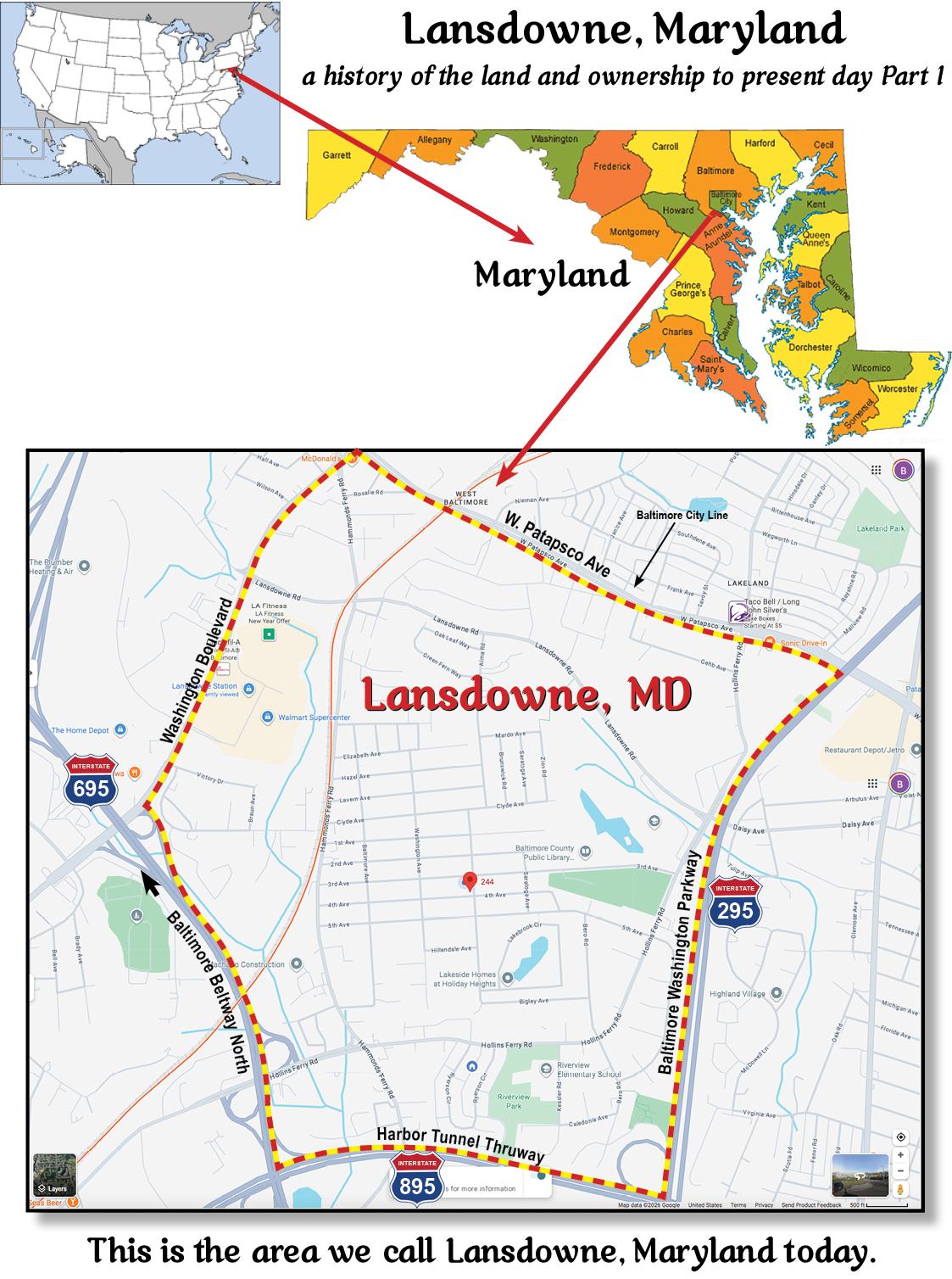
The scope of this document is a more detailed account of the history of the land and its ownership. The earliest known ownership was that of Nicholas C. Carroll in 1835. Prior to a detailed account of owners, there should be a little background education of the ancestors of Nicholas C. Carroll who was a descendant of the prominent Carroll family of Maryland. With few sources of when this line of Carrolls emigrated from Ireland to the United States, it is likely that they acquired the land we know as Lansdowne today in the early 1700s.
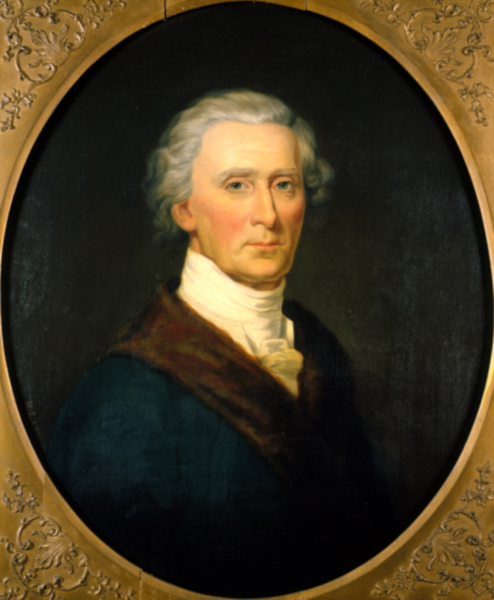
The Carroll family of Maryland was a wealthy, influential Catholic family of Irish descent, whose lineage traces back to Charles Carroll the Settler in 1688 whose son was known as Charles Carroll of Annapolis. The son of Charles Carroll of Annapolis would become known as Charles Carroll of Carrollton. This line of Carrolls became the first major Catholic landholders in the colonies. They were prominent landowners, industrialists, and political figures, with Charles Carroll of Carrollton who was the grandson of Charles Carroll the Settler (a signer of the Declaration of Independence), Daniel Carroll (a signer of the Constitution), and Archbishop John Carroll (the first Catholic bishop in the U.S.) being notable members. The family’s history is tied to the American story, encompassing wealth, faith, and the exploitation of enslaved people, despite their advocacy for freedom.
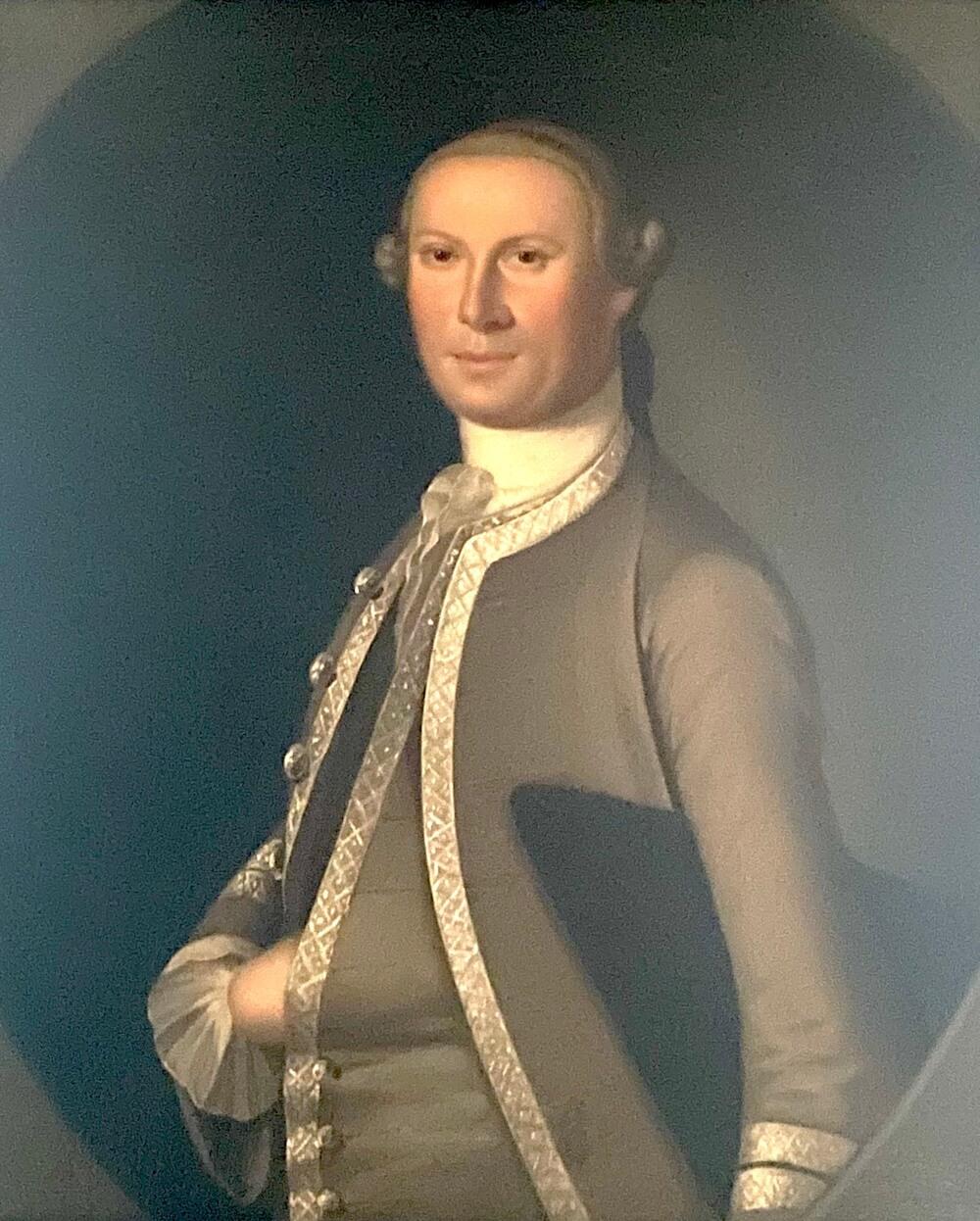
Although different sources indicate that this line of Carrolls originated in the late 1600s, we do know, with more certainty from Maryland Land Records, the lineage of the Nicholas C. Carroll that sold the land we call Lansdowne. His great-grandfather was Dr. Charles Carroll (1691–1755), also known as Charles Carroll, (Surgeon). He was a prominent 18th-century Maryland colonist, medical practitioner, and businessman.
He was born on April 27, 1691, in Clonlisk, County Offaly, Ireland and emigrated to Annapolis, Maryland, around 1715 for political and religious reasons. While he was born Catholic, he renounced his faith around 1738 to become Protestant (Anglican). This allowed him to hold public office and obtain land grants that were otherwise restricted for many Catholics in the colony. The separation of church and state did not become clear until the Constitution was signed in 1787. Charles Carroll, (Surgeon) died on September 29, 1755, in Annapolis, Maryland.
https://www.youtube.com/watch?v=Iz1rnZQfg6w&t=67s captured September 28, 2025
https://www.youtube.com/watch?v=I7mGCS5TQgI&t=13s captured September 28, 2025
The Carroll was a large and extensive family. The Charles Carroll of Carrollton mentioned above is noteworthy to the Lansdowne area not because his extended family owned the land, but because in 1828 he laid the first cornerstone for the B&O Railroad. Lansdowne was one of the first B&O towns. The first B&O stations were at Baltimore’s Mt. Clare and along the initial 13-mile route to Ellicott’s Mills (now Ellicott City), Maryland. In 1892, Lansdowne was becoming a burgeoning area having been purchased by Samuel Crothers from the Linthicum family in 1889. Samuel Crothers divided the area into building lots for city dwellers who wanted to move to the country. In 1892, the B&O erected Lansdowne Station which was located on the west side of Hammonds Ferry Road between First and Second Avenue.
Our history of land ownership that encompassed the land we know today as Lansdowne begins with one of the earliest known owners, Nicholas C. Carroll. Nicholas C. Carroll, who sold the acreage containing Lansdowne, was the son of another Nicholas C. Carroll. His story is interesting because although he was a descendant of the Carroll family, his original surname was MacCubbin. His father was Nicholas C. MacCubbin Sr. and his mother was Mary Clare MacCubbin whose maiden name was Carroll. Mary Clare was sister to Charles Carroll-Barrister of Annapolis. As a matter of clarity, Charles Carroll-Barrister was a distant cousin to Charles Carroll of Carrollton who was a signer of The Declaration of Independence as well as the man who laid the first ceremonial corner stone for the B&O Railroad in 1828. The area we know today as Mount Clare in Baltimore was named after Charles Carroll-Barrister’s sister, Mary Clare.
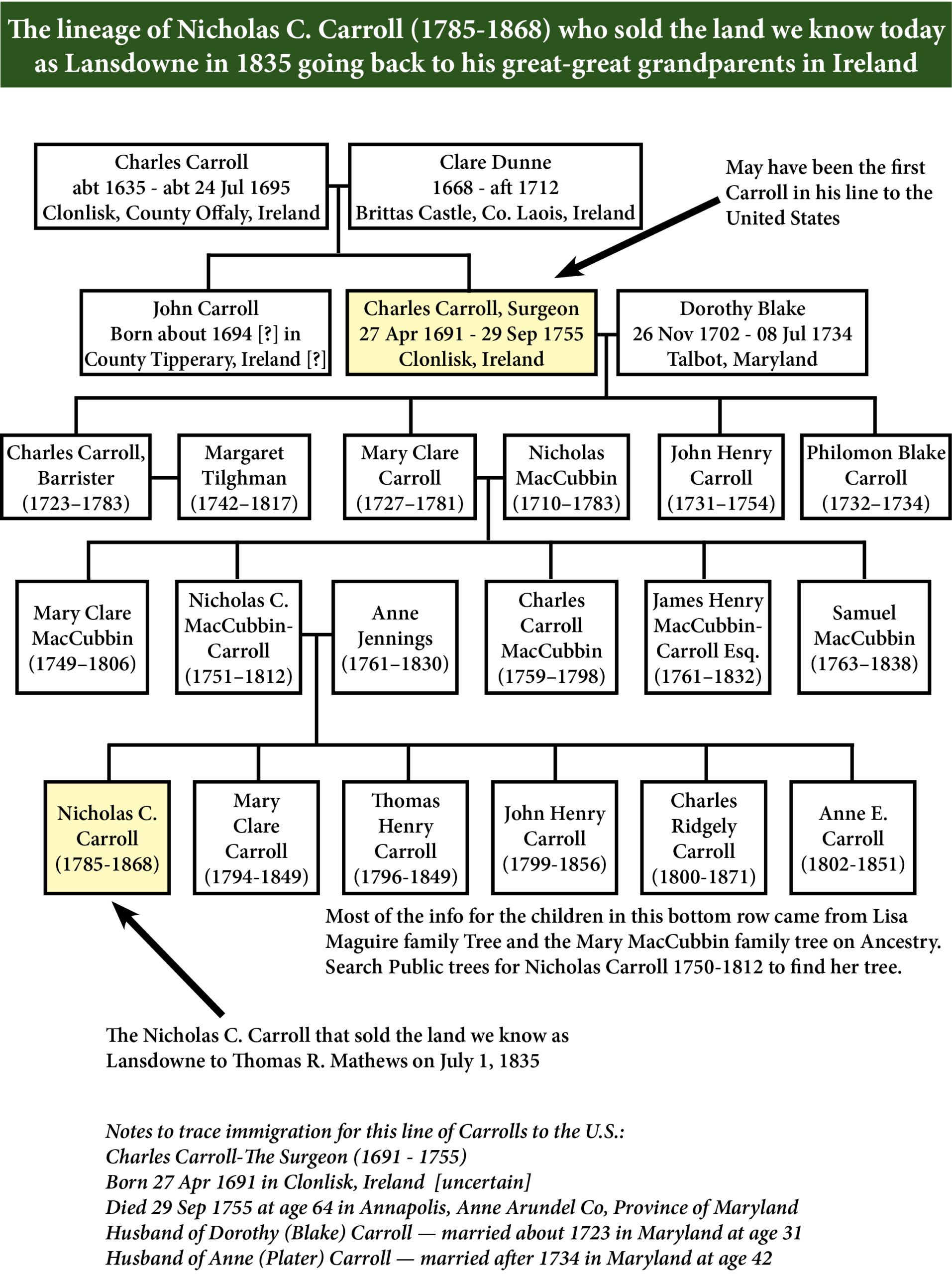
The Nicholas C. Carroll that sold the land containing Lansdowne was the son of Nicholas C. MacCubbin-Carroll who was the nephew to Charles Carroll, Barrister. See the abbreviated family tree below for reference in clarifying relationships.
To distinguish the two Charles Carrolls:
Charles Carroll of Carrollton (1737–1832): This Charles Carroll was the wealthy, Catholic signer of the Declaration of Independence, a member of the Continental Congress, and the last surviving signer. He was educated in Europe and trained in law, and he was a key figure in the republic’s early years. This Charles Carrollton did have children and did sign the Declaration of Independence. On July 4, 1828, he laid the first ceremonial cornerstone for the B&O railroad at the site of the Carrollton Viaduct, which spans the Gwynns Falls stream in Baltimore.
https://en.wikipedia.org/wiki/Carrollton_Viaduct captured September 27 2025
For regional cultural posterity, the stone was relocated to indoor locations. It is currently located inside the B&O Museum, 901 East Pratt Street, Baltimore, Maryland 21201.
https://www.hmdb.org/m.asp?m=243537 captured September 27, 2025
Click here for an interesting read written by Ronald Hoffman on the Carroll family of Maryland.
Charles Carroll, Barrister (1723–1783): This Charles Carroll was a lawyer and a prominent politician. He was a framer of the Maryland Constitution of 1776 and a member of the first Maryland Senate. This Charles Carrollton did NOT have surviving children. This Charles Carroll was the one who had twins that died in infancy. Other than that, he was childless. Without a male heir, he ended his Will with a codicil dated March 23, 1783 stating that Nicholas MacCubbin Jr. must legally change his surname to “Carroll” in order to receive his inheritance. Nicholas was the nephew of Charles Carroll Barrister. His mother was sister to Charles Carroll Barrister.
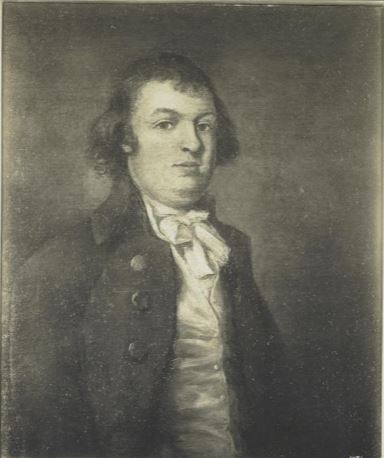
Nicholas MacCubbin Sr. 1710-1783 (father of Nicholas –MacCubbin-Carroll Sr. 1751-1812) married Mary Clare Carroll 1727-1781. She was sister to Charles Carroll Barrister. Nicholas C. (MacCubbin) Carroll Sr. 1751-1812 is identified as senior only because he later had a son named Nicholas C. Carroll 1785-1868. This Nicholas C. Carroll 1785-1868 is significant because he is the one who sold the land containing what would become Lansdowne to Thomas R. Mathews in 1835.
Born Nicholas MacCubbin on March 1, 1750/51-died May 22, 1812 in Anne Arundel County, Maryland. Son of Nicholas MacCubbin Sr. and Mary Clare, daughter of Charles Carroll. Anglican. Married Ann Jennings, October 30, 1783, sister-in-law of James Brice.
1783 was an eventful year for this family. Not only did Nicholas Maccubbin Carroll marry in October of 1783, but his father, Nicholas MacCubbin died March 23, 1783. Sources differ but also indicate that Charles Carroll Barrister also died this year. The reading of his will drawn in 1781 and settlement of his estate began in April 1783.
Nicholas had three brothers: James, John Henry and Samuel and a sister, Mary that were named in the Will. The codicil in the will made the same stipulation for his brothers. As near as I can tell, Nicholas and James were the only two siblings that legally changed their surname to Carroll. Nicholas’ father, Nicholas MacCubbin Sr. was, no doubt, displeased with this request as there is a signed notation in the Will to the effect that Nicholas MacCubbin Sr. renounced his appointment as one of the executors of the Will as he had so been listed.
Nicholas was born March 1, 1750/51, in Anne Arundel County, Maryland. He married Anne Jennings, October 30, 1783. Children: Nicholas; (1785-1868) Thomas H. (1796-1849); John Henry (?-1856); Mary Clare, who married Robert Traill Spence; Ann, who married William Temple Thomson Mason. Nicholas died May 22, 1812 in Annapolis, Maryland and is buried in St. Anne’s Cemetery, Annapolis, Maryland.
In accordance with conditions specified in the will of his uncle, Charles Carroll, Barrister, Nicholas changed his surname to Carroll by an act of the Assembly in 1783. From his uncle, Charles Carroll-Barrister, he inherited 4,370 acres in Anne Arundel and Baltimore counties, as well as lots in the towns of Annapolis and Elkridge. Of this acreage was land containing the what we know as Lansdowne.
https://msa.maryland.gov/megafile/msa/speccol/sc3500/sc3520/000200/000213/html/213bio.html
Nicholas acquired that land sometime after 1783 when he legally changed his surname to “Carroll”. This Nicholas C. MacCubbin-Carroll had a son, Nicholas C. Carroll (1785-1868). It was not until July 1, 1835 that Nicholas C. Carroll (1785-1868) sold the land containing the 86 acres to Thomas R. Mathews that would later become known as Lansdowne. At that time, the area was known as Brunswick.
In 1838, Rosby Carr purchased several tracts of land including the area then known as Brunswick from Thomas R. Mathews. He purchased the land because it was flush with refine-able iron ore. From that point on the area previously known as Brunswick became known as Carrsville. Those today that reside in the Lansdowne community will note one of the streets named “Mine Bank Lane”. So named because it was one of the main routes to one of the iron ore mines. Mule pulled wagons were led to and from the mine to transport the ore to a refinery in Elkridge, Maryland.
On May 28, 1857, Matthias Linthicum purchased that same 86 acres of land still known as Carrsville and used it as farm land. Matthias died on January 16, 1880. I was not able to locate a Will, but did find his record of probate which listed his son, Franklin and his wife, Martha Rebecca Linthicum as joint executors. As a matter of interest, Matthias’ estate amounted to approximately $29,550 in 1880 which is about $935,000 in 2026 dollars. On September 21, 1885, Franklin Linthicum passed away leaving, in his Will, all his property to his wife, Martha Rebecca Lewis-Linthicum.
Martha Linthicum sold the land still known as Carrsville to Samuel Crothers on March 23, 1889. At this point, the area then became known and called Lansdowne. The 1880 obituary for her father-in law, Matthias Linthicum stated that his residence was in Carrsville and that the B&O R.R. would run a special car on the day of his funeral from Camden Station to Carrsville and back for family and friends to attend the service. What this researcher finds curious is that all consulted sources indicate that the Lansdowne B&O station was not erected until 1892 which means there was a B&O station in Carrsville/Lansdowne prior to 1892.
Crothers divided the area into building lots. Charles Wesley Hull purchased a large area of land from Crothers. It is the area we know in Lansdowne as Joshua. So named after Hull’s son. This is the area today between 1st Avenue and Mine Bank Lane. Although still known as Lansdowne, this area is still referenced as Joshua in the State Department of Assessments and Taxation.
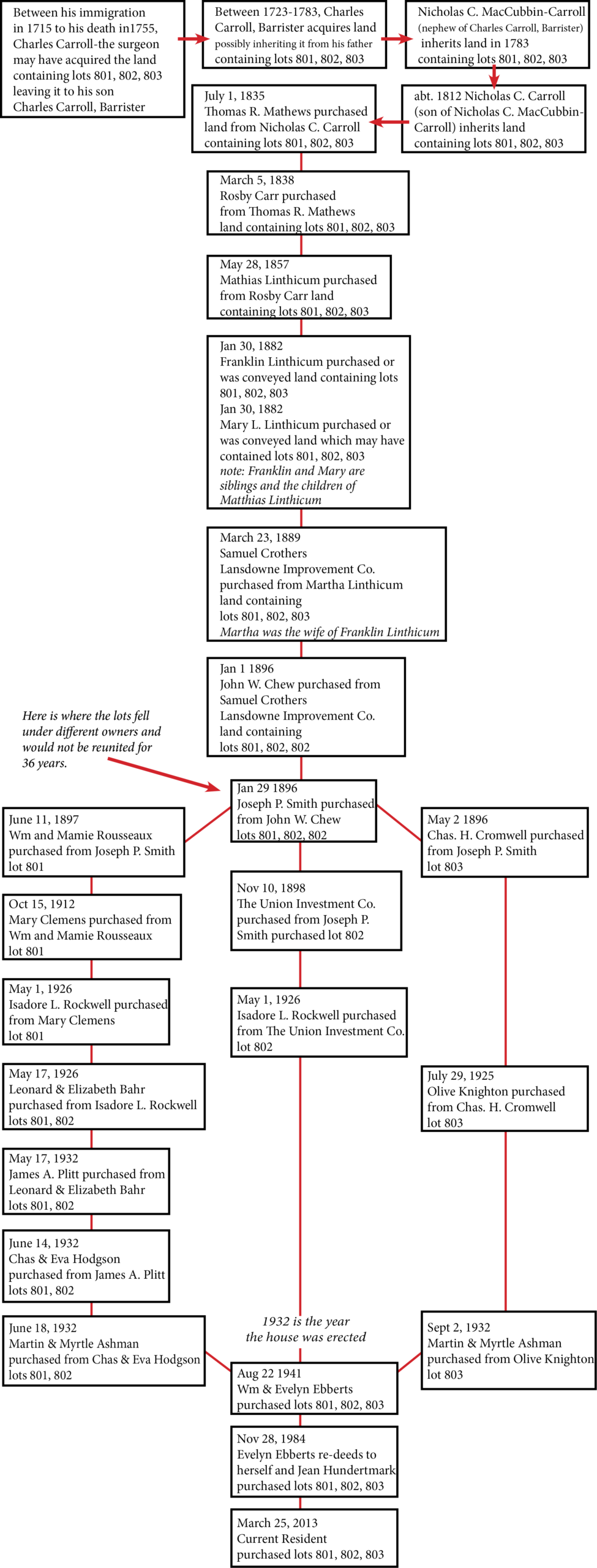
We are going to follow three of those lots from their beginning. You will note that they changed hands multiple times, at certain points fell under three separate owners of each lot and ultimately were united under one ownership before a structure was built upon them.
The entries on the following pages show the earliest known history of a large tract of land that ultimately contained lots 801, 802 and 803 of Lansdowne, Maryland via a plat record dated June 6, 1889. As mentioned, 1889 is the year that Samuel Crothers purchased that particular land tract, created The Lansdowne Improvement Company and divided the land into 25 X 100’ lots for resale to prospective settlers who would build homes on them. The lots were sold or mortgaged at $60.00 each or $10.00 and $5.00 per month.
On the chart below which covers 1783 to present day, you will note that between 1896-1898 lots 801, 802 and 803 began to fall under separate ownership.
It is likely that, due to their affordability, many new-comers saw them as an opportunity for a profitable investment. Without researching more of these lots, I believe the shuffling and multiple transfers of ownership is what happened with man of these lots.
Lots 801, 802 and 803 changed hands multiple times until 1932 when they fell under one owner, Martin and Myrtle Ashman. Martin and Myrtle erected their home there that same year.
On August 22 1941, Martin and Myrtle Ashman sold to William M. and Evelyn M. Ebberts Lots 801, 802, 803 Libre 1178, Folio 338.
On Nov 28 1984, Evelyn M. Ebberts deeded to Evelyn M. Ebberts and Jean F. Hundertmark as tenants in common Lots 801, 802, 803 (William M. Ebberts having died August 15 1977) Libre 6823, Folio 749.
On March 25 2013, Jean F. Hundertmark sold to the current owner Lots 801, 802, 803 (no Libre or Folio available on-line as of Sept 22 2025.